When an international group rolls out Microsoft Dynamics 365 Business Central to its Italian subsidiary, the project is rarely just a matter of adding a company to the tenant.
Italy has one of the most demanding compliance environments in Europe: invoicing, banking, withholding taxes and VAT reporting all follow country-specific rules, several of which have no equivalent elsewhere.
Business Central covers the foundations with the official Italian localization, and the remaining operational layer is typically handled through certified apps from local partners. This guide summarises some of the most common topics when running Business Central in Italy.
Italy was the first EU country to make electronic invoicing mandatory for essentially all domestic transactions, business-to-business included. Invoices are not sent to the customer directly: they are produced as XML files and transmitted through the government exchange system (Sistema di Interscambio, SDI), which validates them and delivers them to the recipient.
Inbound vendor invoices arrive the same way, which means that Italian companies receive structured invoices for purchases as well: an opportunity, since vendor documents can be loaded automatically instead of retyped.
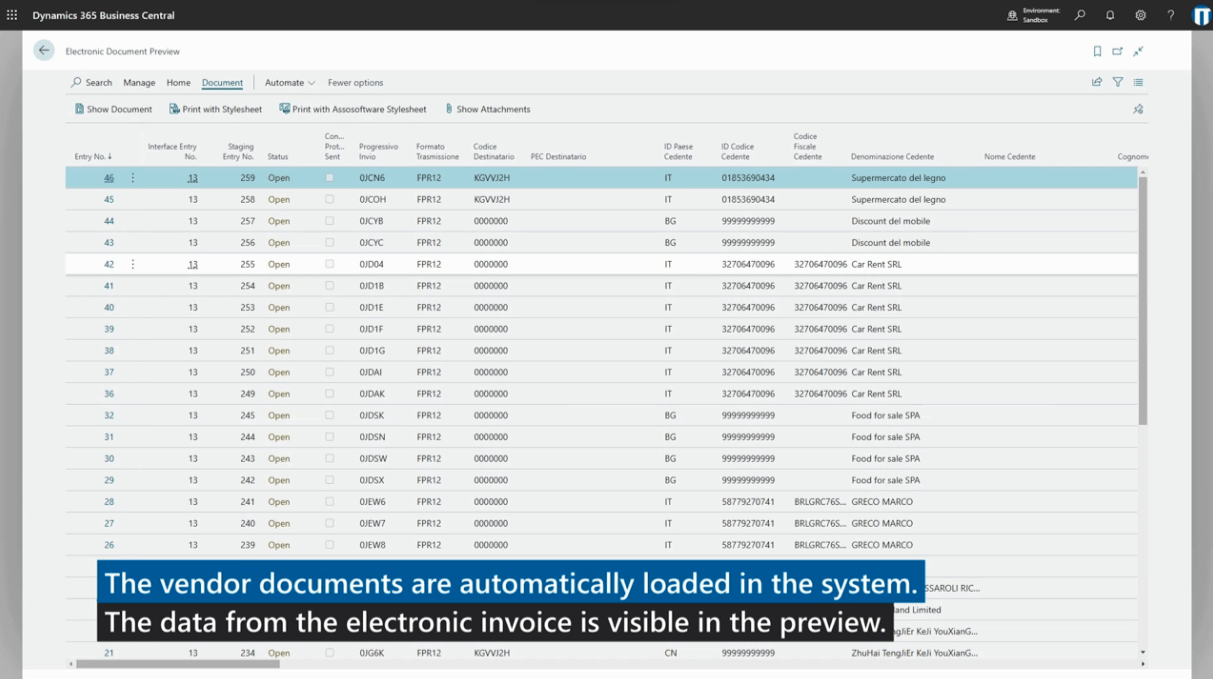
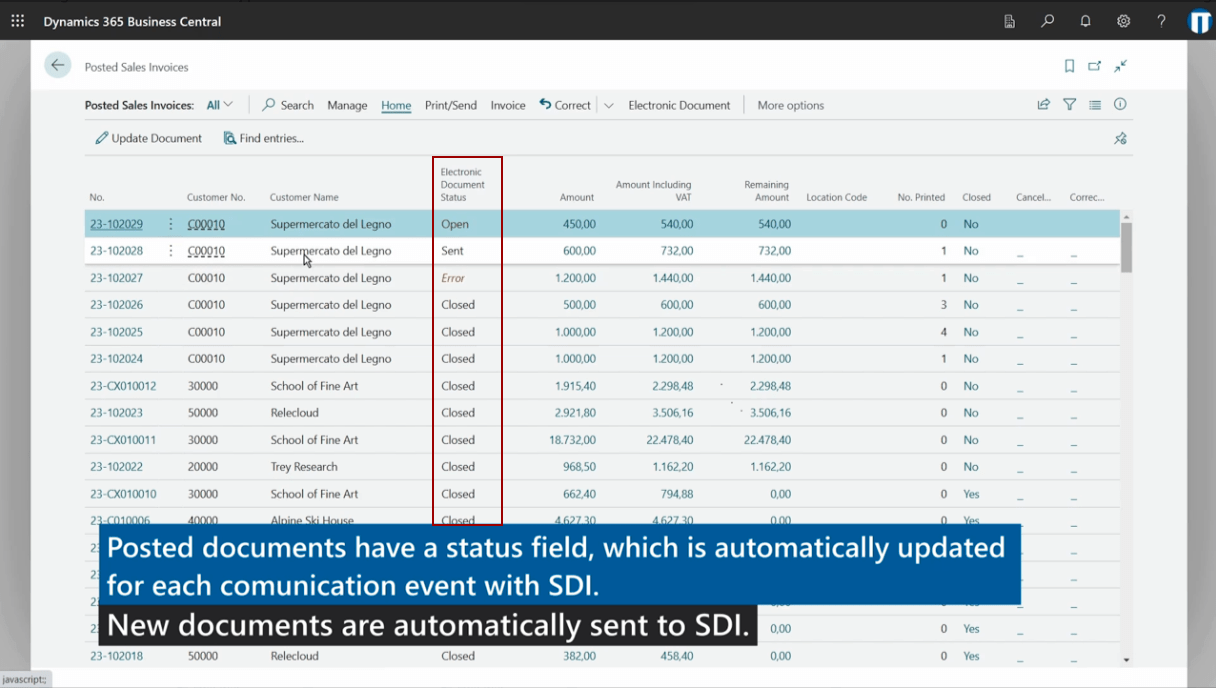
In Business Central this entire flow runs inside the ERP with our Italian Electronic Invoicing app: outbound invoices are generated and sent to SDI at posting, delivery outcomes\notifications update the documents automatically, and inbound invoices are received and matched from within the system.
We described the process in detail in a dedicated article.
If a company also has public administrations as customers, a second layer of requirements on top of ordinary electronic invoicing is added, and invoices that do not respect them will be rejected from the public administration.
Invoices to public administrations must also carry the identifiers of the tender\project they relate to: the CIG (codice identificativo gara, the tender identification code) or the CUP (codice unico progetto, project code). In addition to them, the purchase order reference and date must be reported in the electronic invoice.
Our electronic invoicing app provides everything needed to fill this information on the sales document and exports them in the electronic invoices, preventing issues when invoicing public administrations.
Under the split payment regime, the public administration pays the VAT amount directly to the tax authority rather than to the supplier: the invoice must be issued accordingly, the accounting entries differ from a normal sale and the electronic invoice must contain the specific this information.
In Business Central Split Payment calculation can be automated with our Foundation app: split payment lines are generated automatically and reported in the electronic invoice.
Italian corporate banking runs on the CBI network, a national standard that predates and coexists with SEPA:
Our Italian Bank Integration app support the formats expected by the Italian banks keeping the banking activities inside the ERP.
Italian companies must support the withholding taxes process: when paying professionals, agents and certain other vendors, part of the invoice amount is withheld and paid to the tax authority on the vendor’s behalf. This affects daily accounts payable work: the withholding must be calculated on the invoice, recognised at payment, and settled periodically. In addition, the withholding taxes data must be exported to the government systems on an yearly basis.
The Italian localization of Business Central manages withholding codes and their calculation on purchase documents.
Alongside the daily processing, the withholding data collected during the year must be reported to the revenue agency through the yearly certification. The standard localization holds the underlying figures but offers only basic support for the submission itself, so a subsidiary in its first years of Italian operations often extracts the data and passes it to its external accountant, who files it together with the other year end obligations. When the number of withholdings makes that impractical, our Foundation app produces the export directly from Business Central in the official format.
Italian VAT has some recurring obligations: VAT registers must be printed with legal page numbering, the periodic VAT settlement (liquidazione) must be calculated and its quarterly communication (LIPE) transmitted in the ministerial format, and the annual VAT declaration is based on the full year’s VAT data.
Our Foundation app removes the manual steps required for VAT compliance such as automatic page numbering of fiscal prints, mass PDF generation of VAT registers, controls that prevent wrong VAT code and account combinations at posting time, and the checks on reverse-charge numbering for intra-community transactions.
A subsidiary that buys from abroad, whether inside or outside the European Union, applies the reverse charge: the supplier does not charge VAT, and the buyer calculates it and accounts for it on both sides, as payable and as deductible. The calculation is part of the standard Italian localization and needs nothing added to it.
What does need attention is the documentary side, because Italy requires the reverse charge to be communicated to the exchange system as well: an integration document is produced for the purchase and transmitted to SDI under the appropriate document type. That transmission travels the same channel as ordinary sales invoices, which is why it belongs to our Italian Electronic Invoicing app rather than to the standard localization.
The same mechanism covers the internal reverse charge cases set out by Italian law, in construction and in certain categories of goods, where both parties are established in Italy.
Intra-EU trade triggers the Intrastat declarations for goods and services and Business Central supports it in the standard both for goods and services.
Our Advanced Italian Intrastat extension adds additional functionalities on top of the standard ones: a single cumulative file per period covering goods, services and corrections, the specific submission format accepted by the Italian revenue agency, and default values that remove manual inputs.
Italian law requires fiscal documents to be kept legible and unaltered for ten years, and when those documents are produced digitally the requirement becomes a formal digital preservation process rather than a simple archive. It covers the electronic invoices themselves and extends to the accounting books: the VAT registers, the general journal and the fixed asset register among others.
For a subsidiary that has just started trading in Italy this is rarely the first problem to solve. The books can still be preserved on paper, and in many cases the external accountant already provides preservation as part of the bookkeeping service, so the obligation is met without anything being added to Business Central. Bringing it inside the system becomes worthwhile later, when the volume of documents makes the paper route impractical or when the company prefers to hold the archive under its own control and to run a more efficient and automated process.
Our Conservazione Sostitutiva app manages the preservation of these documents when that point is reached, and introducing it later costs no rework, because it operates on documents that Business Central has already produced.
Reading a list of country specific obligations from end to end can give the impression that an Italian rollout demands a large stack of additional software. The standard Italian localization published by Microsoft is in fact a solid base, and it already covers a substantial part of the ground, including the withholding calculation, the periodic VAT settlement and its quarterly communication, and the reverse charge computation. What decides whether a subsidiary goes live cleanly is knowing how each of those parts has to be configured for the way the company actually works, and where the standard stops short.
On top of that, the electronic invoicing app is usually the only addition a new subsidiary genuinely needs from the first day, because transmission through SDI has no equivalent in the standard product and it affects every sale from the very first invoice issued.
Everything else depends on how the subsidiary actually operates. Banking integration becomes relevant once payments and collections are managed from the ERP instead of the bank portal, and it becomes relevant immediately if Ri.Ba. is part of the agreed commercial terms. Digital preservation becomes relevant when the paper route stops being practical. The public administration requirements apply only if public bodies are among the customers. Each of these can be introduced when the need appears, without revisiting the work done at go live.
Memento is a Microsoft partner specialised in Dynamics 365 Business Central and working both with Italian companies and with the Italian subsidiaries of international groups, including rollouts where the Italian compliance layer is implemented locally.
If your group is planning or already running Business Central in Italy, contact us: a short conversation is usually enough to map which of these requirements apply to your subsidiary.